Long before I started Junior ROTC in high school, I was well aware that there was a certain way that a flag should be treated.
I grew up in a brick six-flat apartment building that rose up right next to a Chicago sidewalk, so a flagpole of any sort was out of the question. However, every summer my family would drive out to Minnesota to visit my great-grandma Mayme there, and though she lived “in town” – population 497 – I am sure that her yard was no less than a full acre.
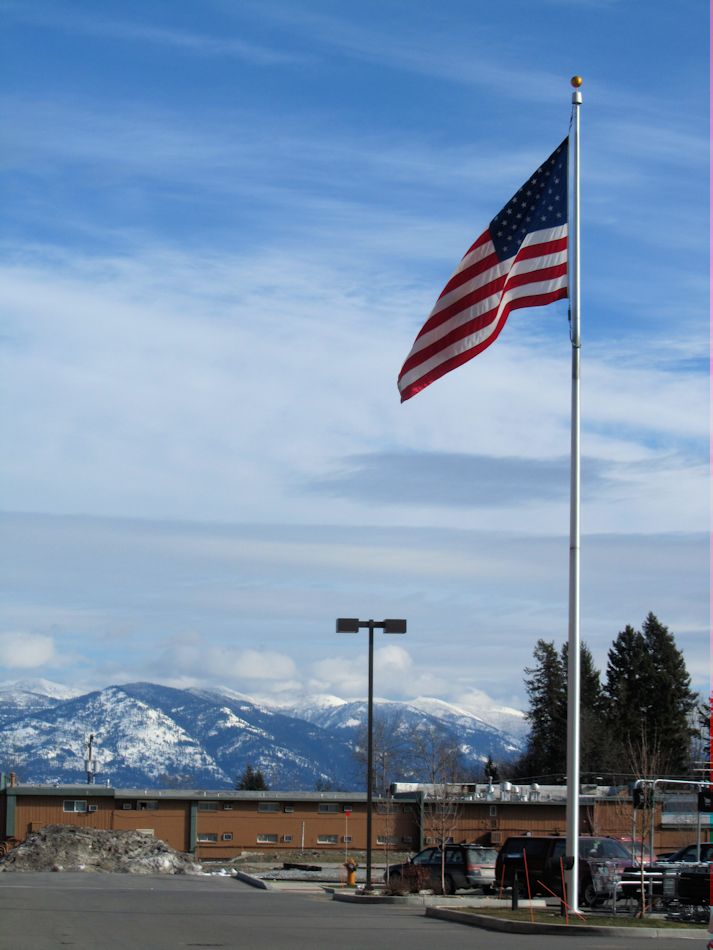
Standing proud as a sentinel next to the driveway, closer to the road than to her house, was one of the tallest flagpoles I’ve ever seen on private property. On that flagpole, she flew a large, American flag.
Her flag was always in excellent condition made of better fabric than I’ve ever seen since. Even into her 80s, she insisted that proper flag etiquette was adhered to. First of all, the flag didn’t fly at night; it didn’t fly in the rain. When the flag was inside, it was folded in a neat triangle and tucked away respectfully in the breezeway. My great-grandmother was one of the sweetest people one could meet, she was quick in her humor, and her blue eyes were always sparkling and jolly. She was always tickled when my sister and I were around, but before we were allowed to put the flag up or take it down for her, boy, did we get an admonishment that the flag should never, EVER, touch the ground!
At eight, everybody who is not also a kid seems ancient. Yes, I was aware that my great-uncle – her son – had died in a war, but to me back then, it was a fact as mundane as the sky being blue. It was a sad thing, but it was also abstract. Things happen. Of course people die in wars, and it would be logical that there would be someone in a family who died in a war. Life goes on. This was my thought process then, because although I understood the facts at a literal level, I didn’t have the life experience to understand them at a more human level.
My great-uncle’s name was Carl, the same as his father, and the same as his grandfather. The line was broken, but both siblings would name sons after their brother, one even using the same middle name. I don’t remember him being talked about a lot, but then again, he had died thirty-five years – an eternity – before I was born. Being from the Lake Wobegone area, first, I could be faulted for assuming that Carl was an above-average child who was morphing into a good-looking man. However, in Carl’s case, it also was more or less the truth.

My grandmother, Helen, was the oldest of the three siblings; she lived in the basement apartment of the apartment building where I lived. Although she didn’t normally start talking about her life when she was young, there was one afternoon when she did, and she started recounting stories, including heading off to the quarry with Carl to go swimming when it was hot, even though they probably shouldn’t have. They weren’t particularly important stories, but for the first time it clicked in my head that Carl was the sibling closest to her in age, and of course her recollections of childhood would be filled with memories of the living Carl, the little brother, the playmate, the kid that life would have been so different without. It makes me wonder if she didn’t talk about those times much because it would have involved talking so much about him. Is it any wonder, then, that her own son, born just short of four years after her brother’s death, would carry her brother’s name?
There was another little thing in my life where Carl came up specifically. As kids, before the advent of caller ID or cordless phones, my sister and I answered the phone as a matter of course. We were schooled in phone etiquette, but at some point we saw on TV someone pick up the phone and answer with a funny greeting. “Roadkill Cafe, you kill it, we grill it!” or some such. My sister and I must have been discussing what we might use, and our mom caught wind of it and freaked out, making it extremely clear that if either of us ever tried such shenanigans, we’d be in big trouble. From what I understand, Jack, the youngest of the three siblings, then barely fourteen, answered the phone call with the terrible news that Carl was killed. Not having any idea who was on the other end or why, he had answered the phone with something like “Jack’s Crab Shack” or something equally silly. My mom didn’t want something similar to ever happen by us.

The other story I was told of Carl was related to me by an aunt during a long car ride. Knowing this aunt, I don’t expect that all the details are right, but here goes. Apparently, Carl was engaged to a “very nice girl” at the time he was killed. According to my aunt, this young woman was given Carl’s medals that were awarded posthumously. I’m assuming that she was somewhere around Carl’s age, and, of course, there is still a lot of time for a twenty-year-old woman to find someone new. Eventually, she did get engaged again, but before her wedding day, she returned the medals to my great-grandparents, knowing that she was moving on from Carl’s death in a way that they never could.
And so, it made sense that my great-grandmother so treasured the flag. Her own parents had suffered to make it to the United States, and her eldest son’s life would be required in service to this country. She had to have known that it was impossible for us, as little kids, to understand any of that, but at the same time, she was serious that any disrespect to the flag would not be tolerated.

If you enjoy my posts, please consider:
- Giving this post a “like”
- Sharing this post
- Subscribing to the blog
- Pledging monetary support
- Subscribing to my YouTube or Anchor.fm channels
- Patronizing the links that support this blog: Lilla Rose | Amazon
Thank you very much!

 Breath of Hallelujah