I got up early Friday morning and drove down into the land of the lost (that is, Illinois), to Trinity International University, making sure to fill the gas tank up before crossing that border. Why? Touchstone Magazine’s 2023 conference. Apart from Fr. Patrick Reardon, I don’t know any of the speakers today, which is probably due in large part to the fact that I haven’t subscribed to Touchstone in more than a decade. Also, I missed everything on Thursday because of coordination of childcare and the like, not to mention that I already had to make one trip down almost to the Illinois border earlier in the day on Thursday for something totally unrelated, but which absolutely could not be combined with going to the conference.
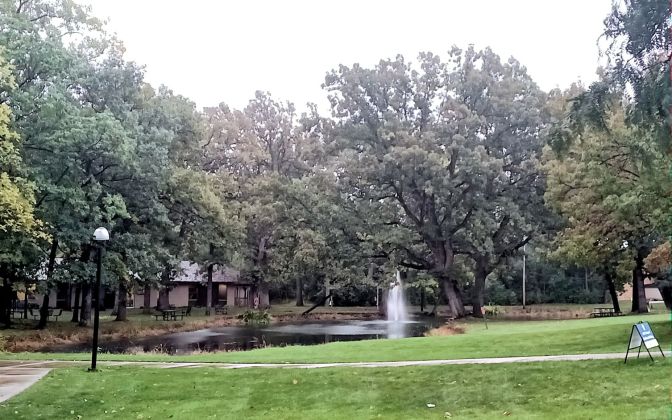
The theme of the conference is “The Crisis in Authority”. It’s an interesting topic, though a lot of the talks have been centered around how science – or, shall we say, scientism – is being put front and center to take over more traditional belief systems including religious belief and the traditional Christianity of Western Europe.
I wasn’t quite expecting that, though it’s an interesting topic. One of the speakers, Michael Hanby, posited that authority can neither be created or destroyed, but rather it just shifts, and that’s certainly a valid hypothesis. There’s been a lot of speaking about the fallibility of science as “authority”, but how it’s different than, say, a bad king, because moving authority to sciences such as artificial intelligence seems to be an effort to move authority past the realm of even the human. In that way, it reinforces the effort that the reigns of power would only be in the hands of an elect few, and implicitly, that decisions regarding life and death boil down to algorithms, statistics, and probability.
It seems like a lot of this veneration of science of supreme came out of the Enlightenment in the West, in an effort to shake off mysticism and superstition, which did not exclude some Christian practices. However, as much as that might have been driven off (and to our detriment, in part), we’ve just built our own replacements here, calling that progress.
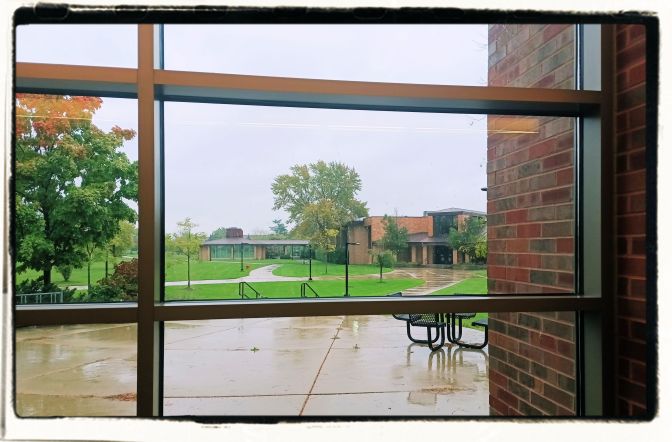
The other theme is that when one removes the authority inherent in the Truth, the structure by which we discern what we perceive is destroyed, and everything incomprehensible. From the very beginning, a baby learns to take the sights and sounds and create patterns of comprehension in his brain. By attacking the concept of an objective Truth, taking a look at the world again is incredibly overwhelming. We see tables and chairs and doors and trees because we have learned that order; we don’t see them as random concepts of color.
The speakers were quite good, though this is a very academic crowd. A number are professors, and are used to speaking to groups, but I also found a couple of the speakers in the morning somewhat difficult to remain focused on for their entire presentations. I take notes to help me with that. The crowd is really a tough one to speak to, in some sense, because I’d guess about a quarter were seminarians and probably a quarter were clergy, and at least half of the rest were senior citizens, both men and couples. Of course, I didn’t talk to everybody there, but I think I was 1 of about 2 women who were there without husbands between the ages of about 25 and 60. The woman whom I did meet in that category was… a former seminarian at Trinity International University who was in pastoral ministry of some sort in Iowa.
It was an amazing day, and I’d like to write about the “other part” of the conference separately, but for anyone who is interested, the following are a few words about each speaker individually:
Douglas Farrow was the first speaker, and, unfortunately, I didn’t write down the title of his speech. He spoke about living a Christian life under the authority of God’s law and man’s law, and how Christians need to follow God’s law first. He spoke a bit about how the churches failed to exercise their authority in modern days, especially during Covid. He mentioned the Maccabean martyrs, which made me happy, and of community and of certain legal battles currently or recently going on. Totalitarianism, in trying to be its own savior, ends up with a created madness for going against the natural order of creation.
“Without apostasy in the Church, evil cannot stand”
“Evil is parasitic on good”
“Be ready to suffer for the good”
“When liberty gives way to license, license devours liberty”
“In order to live the quiet life, it is a necessity that one is willing to resist evil.”
R.V. Young was the next, with his speech “The Rout of the Muses”
Young started off by talking about the advent of art which is not art, transgressive art, which he illustrated with talking a little bit about Marcel Duchamp’s 1917 “art” piece, “Fountain“. From that place, he talked about how even “cultured” art reviewers hardly actually deal with real art – magazines, for example, having their critic review a coffee-table book of Paul McCartney book of snapshots from 1964, or discussing whether the Barbie movie is actually liberal or conservative. He spoke about how, when there are no standards for truth or beauty, “art” becomes merely a way to get across the political, and it’s only evaluated as to whether it is useful in the political game or not. This sort of attitude towards art results into a campaign of destruction against real art. Regardless of the sphere of art, real art does something to represent the experience of human nature, and has structure and form, otherwise it is, for example in the musical realm, just a bunch of noise. He talked a little bit about teaching Moby Dick in high school, and over the years, the story becoming more and more unintelligible because fewer and fewer of the kids had the knowledge of the Bible to understand it. Furthermore, many of them no longer had Bibles in their home to even try to fix that hole in their knowledge. He also touched on how things like “Music Appreciation” classes have been disappearing over the last 50 years, in large part for the push to greater “diversity”. He also made a plea that people really take responsibility for the things that they feed their brain in what they watch, read, listen to, etc.
Michael Hanby was the next speaker, and again, it looks like I didn’t take down the name of his speech. I mentioned before that he said that authority can’t be created or destroyed, but without authority being put in its proper order, we end up in a situation like today where we seem to be “careening toward an autopilot totalitarianism”. He connected the idea of fatherlessness, and I think here it would have been good to connect authority to responsibility, to the tendency to push authority off to some other entity, to the point where if one can push it off to “science” or “technology”, we end up with so-called “authority” via machine. This structure is almost by definition totalitarian, because “science” and “technology” may not be questioned. From there, it’s much easier to disassociate authority from truth, which inevitably leads to dehumanization. However, reality is on our side, and our job is to do our best to remain there.
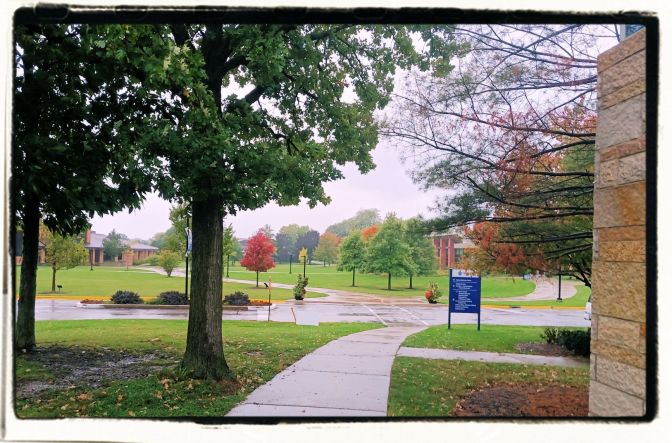
Thomas S. Buchanan was the next speaker, and he came up to the podium to give his talk, “The Authority of Science” in full professor robes and cap. The point was to show how something like what one wears can give one the air of authority, but it was pointed out, too, that the professor robes were meant to echo the clerical robes because in the beginning the professors were also clergy. However, in the modern times, the scientists have kind of created their own new priesthood and religion in “scientism”. He talked a little about the old debate about religion vs science, but also how people’s trust in “science” has taken a huge hit recently. He talked about the “reproducibility crisis” in science, particularly in chemistry and biology, where “breakthroughs” in knowledge often can’t be reproduced even by the same scientists, and how, for example the 1949 Nobel Prize for medicine went to the doctor who had come up with lobotomies. He talked about “scientism” as its own type of religion, Fauci being an example of that (“I am science”). However, belief in this leads to “moral concentration camps” and “spiritual genocide”, whereas true science allows the questions to be asked and assumptions to be challenged. He ended with a list of things to do to fight against these things – Speak out. Don’t be bullied. Be brave. Do not be afraid. Pray. Know that Christ is always with us.
Fr. Patrick Henry Reardon gave a short speech entitled “Constantine” in which he compared King Cyrus of the Old Testament as being the “Constantine” to the Israelites the way Constantine was to the Christians. Both were outsiders who were instrumental in the growth of these religions. He also did a lot of talking about Psalms 1 and 2. The thing that made the King Cyrus connection especially interesting to me is that in one of his videos (perhaps with Jonathan Pageau) Jordan Peterson marvels at the role of King Cyrus in the history of the Old Testament, seeing it as an example of Truth being recognized from someone not attached to the “in-group”, making the idea that there is an actual, objective Truth more plausible.
The last speaker on Friday was Adam MacLeod, who had the crowd transfixed with the beginning of his speech, “Law’s Essence and the Authority of the Imago Dei”. You see, he started by quoting Genesis with God’s command to Adam and Eve to be fruitful and multiply, and he went into Adam and Eve’s postmodern word-salad responses to God, which were hilarious. The meat of his speech was more serious, though, talking about how law is essential to the functioning of society, and that this has been true since ancient times, how the rule of law has been lost in principle, and ways that he sees to get it back. It was fascinating, but also very, very dense as far as the ideas and presentation. In the old, Christian sense of law, law was independent of power, but when it is pulled from that foundation, people have gotten into the system who cannot conceive of law as anything but power, and that causes all sorts of problems.
“Returning a mad man to his right mind reveals the image of God within him.”
If you enjoy my posts, please consider:
- Giving this post a “like”
- Sharing this post
- Subscribing to the blog
- Pledging monetary support
- Subscribing to my YouTube or Anchor.fm channels
- Patronizing the links that support this blog: Lilla Rose | Amazon
Thank you very much!

 Breath of Hallelujah
Thanks for a taste of Friday’s talks. I always thought the Touchstone event sounded interesting, but you confirmed my suspicion that it would be a gathering of male geezerdom. Not, you know, that there’s anything wrong with male geezers … if you ever felt it’s something you could address, I’d be curious to hear why you haven’t read Touchstone in many years.
LikeLiked by 1 person
There certainly were more men there than women; I’d guess about 60-40, 65-35ish, if I had to guess. There were a good number of younger women there, but it was obvious that they were either seminarians, dating/married to seminarians, or both. There were some women who were between the 25-60 range, but just about every single one of them was there with their husbands. It was only with the over-sixty crowd, for whatever reason, that I noticed a number of women there who were there by themselves. It was rather odd.
I worked for a Catholic foundation years ago; one of the things that we really were up against was that the culture of large events for fundraising and the culture of philanthropy as a matter of course seemed to be a given with the generation before the Boomers and then died by the time Gen X came around. Learning how to fundraise among younger people is a lot harder for a number of reasons, and with the makeup of the people in the room, I would guess that Touchstone is struggling with this too. I had a fantastic time, even being in an odd demographic for the attendees, but I think I would tweak a couple of things for next time if they asked for my input.
My beef with Touchstone had practically nothing to do with the magazine itself. I originally subscribed to Touchstone back in the days when I was newly Orthodox, so, probably around 2003. It was a helpful lifeline to English-speaking Orthodoxy (though Touchstone isn’t an Orthodox magazine per se). When Salvo started, I subscribed immediately. In any case, I ended up working for that Catholic organization, and, starting in ’08, attending a church where a lot of Touchstone people went. I was thoroughly unimpressed by the attitude a couple of people who were high up in Touchstone seemed to have – not even snobbery, it was like “I don’t even see you because you are that unimportant.” That ticked me off, but what made it worse was when somebody “famous” came to visit and made it known he knew me, one of these people could pretend that he knew me – for that day. On the Salvo side, I liked the idea of the magazine, but I felt the writing was sloppy and illogical for the sake of being “cool” and “sensational” – and then a woman who worked there called the place where I worked and was pretty rude to me (she didn’t know I was a subscriber) so I just decided to stop subscribing to both. That was many years ago, though, and I even found out that somebody I know and like is in charge of Salvo now. I got a free Touchstone subscription from the conference; I might have to give Salvo another try as well.
LikeLike