Friday was the third day of the Touchstone Magazine annual conference, and another short day, as things were scheduled for the morning only. The highlight, of course, was Rod Dreher’s talk, which was the entire reason why I had decided to attend the conference at all.
The night before, after the official events of the conference was over, there was an informal reception at the hotel across the street. Many of the conference attendees were staying there as well, so it was a lot of fun to kick back and talk to people who were there. The speakers at the conference came as well, and it gave people an opportunity to meet the speakers and chat with them. I was really privileged to have gotten a chance to meet and chat with Rod Dreher. I will say, I was very impressed, and he was very nice and seemed absolutely genuine. He actually recognized me from all the commenting I do on his blog, which… wow. The conversations really did feel like chatting with an old friend.
I ended up getting home well after midnight; it didn’t take quite the hour and a half I had estimated, but driving back in the rain wasn’t fun at all. Once home, I had a very strong sense that I needed to get everything together that night for the morning, so I did, even though this is not generally how I operate. I was really afraid that I was sleep through my alarm, so even though I use my phone to wake me up probably at least 80% of the time, here I was double-checking that I had set the alarm correctly.
God does seem to have a sense of humor with these things. I was starting to get minimally conscious, when, at 5:50am, the power in the house went out. No, this would not affect my phone, but I have my computer plugged into a universal power source in my bedroom. As soon as the power went out, that thing started blaring out “BEEEP! BEEEEEP!” (It also wasn’t the only thing in the house beeping because of the power outage.) Yes, I was awake, and yes, I could still easily get dressed and out the door without power because I had gotten everything ready the night before.

Once again, I got to Trinity International University early and I took the opportunity to go through more of the books that Eighth Day Books had there. (I also managed to notice that the ceiling above some of the books was dripping. Luckily the books that got wet only had drops of water on the covers that could be wiped off; an hour later, there would have been a good bit of book carnage.)
In any case, I got myself a seat on the center aisle near the front, and tried not to take up too much space with my purse, laptop bag, books, umbrella, conference notebook, etc. *L*
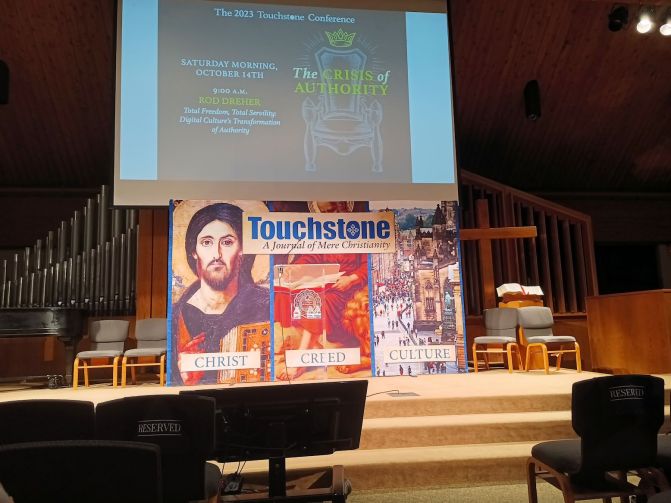
Rod’s speech was called “Total Freedom, Total Servility: Digital Culture’s Transformation of Authority”. The following are notes I took from the talk:
There was a large backdrop behind the speakers; Touchstone has used these images for a long, long time. One of the photos featured is of a European city with what looks to be a castle-ish university on the left side. I had actually been wondering where the picture was from all of the day before, and I was glad that Rod identified it as the University of Edinburgh, in Edinburgh, Scotland. The reason he brought it up though tied in nicely with the speech; that the university has gone completely woke, citing from a Sebastian Milbank piece from the day before.
The struggles for culture matter.

He went on to talk a bit about having broken his laptop screen the night before flying to the US, and how easy it was, being a MacBook, to go to the Apple Store in New Orleans, get it replaced, and have the data restored with very little issue.
From here, he launched to how there are absolutely advantages to the Internet revolution; in his own life, he hasn’t been tethered to an office since 2011 and he’s able to work from practically anywhere in the world with an internet connection, but that there’s a lot that we have to really be wary of in this new era. “The Machine” is happy to create for us a bespoke experience in any number of ways, but at the same time, all that information that is being gathered is being used to compile data on us, to know where we go, who we meet with, what we might be thinking. From that, it’s not hard to start working on a “social credit system”, complete with electronic monitoring of people, even in the West. At this point, there’s still political will to hold it back, but that is eroding.
He switched tack a bit and started talking about societal trends such that herald a collapse in society, the collapse of authority, lawlessness, the way institutions have lost the confidence of people. While much of this is common sense – people really shouldn’t put their trust in things that obviously don’t deserve it, the results of that are kind of scary as well.
He made the point about religious man vs psychological man, that “religious man” seeks the Truth, but “psychological man” seeks well-being.
Coming back to the technology a bit, the 1984 model isn’t what we’ve found ourselves in, but rather Brave New World, where there’s a kind of “therapeutic totalitarianism”; life can become easier, but it’s at the price of one’s soul.
There was one line that really reminded me of Jonathan Pageau, and that was “You are what you pay attention to,” but then he tied that back to smartphones, and boy, is that an issue these days! The smartphones are incredible tools, but they demand from us our attention like nothing else. In some sense, they are the first “natural technology”, and they really make the idea of humans merging with “the machine” more and more of a reality, as the line between real and virtual gets harder to discern, and this is becoming the new framework in which we live.
At the same time that this technology – not just the smartphones, but other things – make life more “frictionless”, it’s important that we stop and understand what the cost of a “frictionless” society is. As Christians, it’s not like we’re not going to not use the technology, ever. For many of us, that’s not even possible. However, for example, if all our books are digital, how easy it is to erase or alter books with unpopular ideas without having to rip pages from the book on your bookshelf. Cashless society? There are records of every transaction that you make. Smart home? The power goes out and there’s no way to use the heat or locks until things come back online.
Things get even more insidious, though, when one thinks of the potential of practicing medicine by AI (this is your predicted life expectancy; we will do nothing beyond this point) where the authority over life and death is handed to a machine.
Again, this isn’t to say that the technology itself is evil, but when more and more authority is handed off to a force we don’t understand, it opens up ways for bad spirits. He pointed out that there are people in the highest levels of this technological revolution who absolutely see the technology, and particularly AI, as a way of “creating God”.
He spoke a little of Diana Pasulka, who has done a lot of research into “ufology”. She’s written two books on the phenomenon, American Cosmic and Encounters: Explorations with Extraterrestrial and Other Non-Human Intelligence (which comes out in November), and from what Rod says here, it seems like there is a strong tie-in between “UFOs”, “non-human intelligent beings”, technology, and probably demons. I don’t remember if it was in the speech or on his substack that he said that when he read Fr. Seraphim Rose’s book Orthodoxy and the Religion of the Future, when Fr. Seraphim wrote that UFOs would have something to do with the heretical religion of the future, he didn’t think that much of it, but having now read some of Pasulka’s work, he’s convinced there’s something to it.
Rod gets a lot of “harassment” about being a “doom and gloom” writer. I don’t necessarily find that, but he’s pointing out things that are uncomfortable that people should pay attention to. He does this not to give people reason to despair, but that by writing about these things, people have a method of seeing what is happening and resisting when possible. He ended the speech by talking about how we must choose the strong path, choose the cross, that by overcoming the “evil” of suffering, we’re in a place to be free.
(Complete video of Rod’s speech; forward to about 14:50 for Rod alone: https://www.youtube.com/watch?v=iqH0pfh5iDE)
I’d say that was about it for Saturday, but I there was a panel discussion that followed. Of all the presentations, the panels were, by far, the weakest part. Ken Myers of Mars Hill Audio (and formerly of NPR) did the moderation, and it was terrible. For the first panel discussion (Friday), I literally closed my eyes and listened whilst half-asleep, and I don’t think I missed anything. Myers tended to start rambling on about something, and then switch over to a question that took a long time to formulate. Furthermore, his questions were oddly specific enough that there was usually only one person on the “panel” who could answer each one, and sometimes he let panelists sit there for ages saying nothing because none of the questions were directed to them. The Saturday panel was somewhat better than the first panel, mainly because Adam Macleod and Rod Dreher were part of it. Poor Brad Littlejohn sat there for ages and ages with nothing to say. I know it’s hard to come up with questions “on the fly”, so to speak, but rather than ask Rod something specifically about the UFOs, using points where there were similar themes between the speakers probably would have been a good starting place – I believe both MacLeod and Dreher talked about how language gets “shifted” under totalitarianism, comparing and contrasting their experiences with it probably would have been more engaging to watch than the questions that did get asked. The speakers I saw were fairly light on the “What’s a Christian to do in these times?” and hearing different opinions could have also been a starting point for a panel.
I wasn’t sure how I was going to structure my posts about the conference; at this point, I think I’m going to do one more post to talk about my general impressions of attending the event. I really had a good time, and I want to stress that most of all. If you have missed the first part of me writing about the Touchstone conference, part 1 can be found here: https://breathofhallelujah.com/2023/10/17/at-the-touchstone-magazine-2023-conference-part-1-day-2/
If you enjoy my posts, please consider:
- Giving this post a “like”
- Sharing this post
- Subscribing to the blog
- Pledging monetary support
- Subscribing to my YouTube or Anchor.fm channels
- Patronizing the links that support this blog: Lilla Rose | Amazon
Thank you very much!

 Breath of Hallelujah
One thought on “At the Touchstone Magazine 2023 conference, part 2 – day 3”