Maybe it was the stories of Daniel in the lion’s den, or the stories of Christians holding on to their faith under the yoke of Communism that I kept hearing in school in the 1980s, but for the majority of my life now, I’ve been intrigued about why people resist tyranny. Obviously, it would be much easier for them to keep their heads down and not attract undue attention and do their best to get through it.

The tyranny of Adolf Hitler and the Nazis is one that is easily misunderstood. We can comfortably look back and say, “Well, of course he was a monster,” but it wasn’t necessarily so easy coming into it. Besides the legal pressure to conform, the societal pressure was incredible as well, after all, if someone didn’t want Germany to succeed, they must certainly want his friends and neighbors to end up as slaves to another power. Blood traitors and all that.
Yet there were those few who risked everything to stand up. I’ve gone deeply into the history of the White Rose. Franz Jägerstätter was also one of these, though he did not attempt to encourage any widespread resistance to the Nazi regime, through his faith, he got to a point where he felt like swearing allegiance to Hitler was a sin, and he simply would not do it, come what may.
This movie, which came out in 2019, is very atmospheric. The majority is set in the mountain village in Austria where Franz Jägerstätter, his wife, and three little daughters lived. When his friends and neighbors find out that Franz refuses to “help the cause”, they put enormous pressure on the whole family to change their ways. After all, if their husbands, sons, and brothers are fighting for Germany, why should this man refuse? Yet the Jägerstätters continue on, bearing it all to the best of their ability.
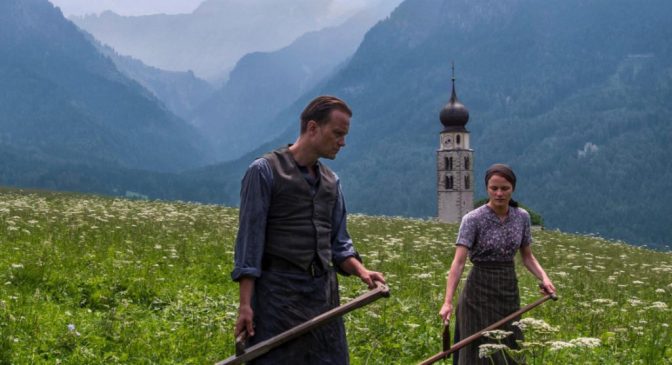
What was somewhat surprising was seeing how, even in the 1940s, in this remote place, how much of the farmwork was done by hand. It seems like due to the location in the mountains, there wasn’t even a lot of farm work done with animals, that everything happened – the planting, the sowing, the reaping – through backbreaking labor, and that when Franz is away, his wife Fani has to take that up. But what other choice does she have? The men are away and if these things don’t get done, they starve.
Even so, Fani Jägerstätter supports her husband until the end. In fact, some of the people felt like Franz became more religious because of her, and to a large degree, it was her fault that he did this. It seems like it is only when Franz is in prison, awaiting execution for his “treasonous” activities, that there starts to grow a begrudging respect for the Jägerstätters, because by the summer of 1943, there were actually plenty of people who knew Germany couldn’t win this war, and they knew their men were being sacrificed in the name of an evil tyrant.
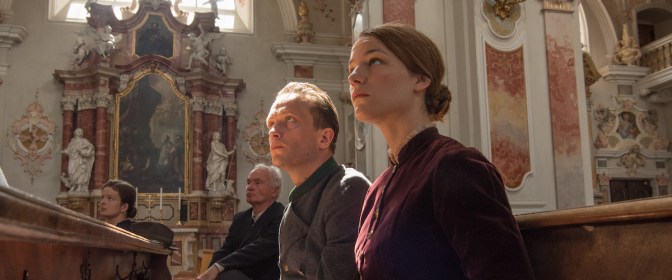
I liked the movie quite a bit; apart from the heavy subject matter, there’s nothing objectionable – no swearing, no sex, etc. My 7-year-old caught me watching and watched with me for at least a half an hour near the end. I stopped watching before the execution because I wasn’t sure how they would handle that, and I didn’t want a traumatized child on my hands, but when I watched the last five minutes by myself, there was nothing there that would have been terrible for her to see.
It’s interesting, too, how they handled the language. The entire cast is German-speaking, but they speak English for the film. There’s a fair amount of “atmospheric” chatter that happens in German – even some that does sound somewhat more in dialect than standard German, and for the most part, I think that worked.
I feel like I do want to watch this movie again. Despite what happens, the location and cinematography are breathtaking, but at the same time, the director did a good job of demonstrating that the life up there wasn’t an easy one. Franz Jägerstätter stood up against the powers that be for the sake of his home there, the irony, of course, being that because he resisted, he was taken from that home and thrown into a prison under terrible circumstances, never to come out again alive. Here is where the common thread with a large number of those who stood up against tyranny can be found; as much as he loved his life, he loved God more, and walked in the certainty that there are worse fates that can befall a person than physical death. Franz Jägerstätter’s life bears witness to that, and to God’s truth, which he stood for. The Catholic Church beatified Jägerstätter as a martyr in 2007, and his feast day is May 21, on the anniversary of Jägerstätter’s baptism.

If you enjoy my posts, please consider:
- Giving this post a “like”
- Sharing this post
- Subscribing to the blog
- Pledging monetary support
- Subscribing to my YouTube or Anchor.fm channels
- Patronizing the links that support this blog: Lilla Rose | Amazon
Thank you very much!

 Breath of Hallelujah