-
Sunday Gratitude – 2.VIII.2026

Boy, has it been busy the last couple of weeks! More appointments than I could shake a stick at, and a couple of weekend events as well. I’m very grateful that things pretty much went off without a hitch, and appointments were met, things a t home have been pretty quiet, and events were enjoyable.

One of the events that I went to last Sunday was German Fest in Milwaukee. I had toyed with the idea of biking the 16 or so miles up to church, and then continuing on the eight from church to the fest, but I’m happy that I didn’t do that. Instead, I put my bike in the car and drove up to church, changed quickly afterwards in the bathroom, then biked the 8 up to German Fest. I had never biked along the Lakefront Path before, and it was really beautiful, albeit busy with people, making it impossible to go very fast. For me, one of the draws is that I get to see people I know, and so that was really fun. (I just wish my German dress still fit me.)
I biked the 8 miles back to the car, and at the end I was tired, and I was grateful I didn’t have 16 more to go, but I didn’t feel terrible either. Last year, I parked in a place where it was a four mile ride from my car to the fest, and on the way back, I felt like I was dying. However, I probably hadn’t even been on a bike in at least 2-3 years before then. And now, well, between the Thursday afternoon before German Fest and the following Friday afternoon, I biked over fifty miles, and it was challenging, but fun. 🙂 I’m grateful for the opportunity to be working on my health.
Silly thing, but my older son was looking for 32 gigabyte SD cards for something. I figured that that was easy enough; as long as I can remember, those things aren’t wildly expensive. Imagine my shock when I walked into Best Buy to get one, and they all seemed to be over $45. Insane. I told him to hold off on buying one, and though I often have miscellaneous extra memory cards and such around, there was nothing that would help him in this instance. Mind you, though, that I haven’t purchased any of these in at least 3 years. The next day, he and his sister went to the gym, and I decided to check out WalMart. Wouldn’t you know, but the price was almost as bad. However, there were two associates who came up right by me, one of them holding a plastic case. Wouldn’t you know, but there were two 32GB SD cards in it. They seemed to be confused about where they wanted to put the item, as it had originally come from the outdoor section, as these two were marketed for trail cams. Nobody is looking for SD cards in the outdoor section! I’m sure this is why this was marked down to $8.50. I proceeded to ask if I could buy it, and they were happy to oblige me, as that also meant that they didn’t have to find a place to put them in the case. I am very grateful I didn’t have to shell out three times as much for the same item.
After German Fest, I went over to my church’s church picnic. That was fun, too. The location is great, and it’s nice to hang out with good people. Summer days are beautiful like that.
Speaking of summer days, we finally got some rain. I don’t think it rained at all in July until the 27th and it was kind of sad seeing everybody’s lawns turning brown. I had mowed right around the last week of June, and I had meant to a couple of weeks after that, and I actually started to, but after about 10 minutes of mowing, I twisted my ankle and it hurt too much to keep going. By the next day already, I didn’t know if it was safe to mow, but it was interesting to see how those strips that I did mow turned very, very brown, and I’m grateful I didn’t cut the whole lawn and have it looking like that.
On the weather front, we had strong storms that came through on the 27th. Friends of mine in Milwaukee had power knocked out, but here, thankfully, we kept power, there was no hail, etc. Unfortunately, this was not the case in all of Wisconsin, and the town of Menasha, in particular, got hit badly. My kids and I signed up for an event months ago that takes place in this area; once I heard that there was a tornado, I checked back to see if the event had been cancelled. It didn’t seem to be, so we drove up to the area and just happened to end up on the street here that this man is driving on in the first 3 minutes of the video here.
How did I end up in Menasha? Well, our first destination was in a small town called Combined Locks. The driving on the interstate had been miserable due to rain, and at a certain point, I couldn’t take it any more, and looked for the first exit off, knowing I could come up the western side of Lake Winnebago to get to where I wanted to go. It just happens that Menasha is pretty much on the western side of the tip of Lake Winnebago, so by getting off the interstate, it pretty much meant going through Menasha. It was weird, too, because at first, I just noticed that there were a lot of tree branches and stuff on the sides of the road, and it kind of dawned on me that that must have been a result of the storm. I did not know that within about 15 minutes, we’d be driving through a disaster zone like this. The crazy thing is, though, that once I got through Menasha, my destination was about six miles down the road, and over there, things looked completely normal. For as bad as the tornado was though, it’s amazing that not a single person was killed – certainly something to be grateful for.
The event that the little kids and I went to was a bike ride/music festival called “Bike to the Beat“. The event took place on Saturday, but the four of us made a little mini-vacation out of it, and it was an awful lot of fun. The drive up was absolutely horrendous, lasting 4 hours when 2.5 is more normal. It rained the whole time and there were accidents and road construction in the Milwaukee area. I was so incredibly grateful both to get off the interstate and to actually arrive at the hotel.
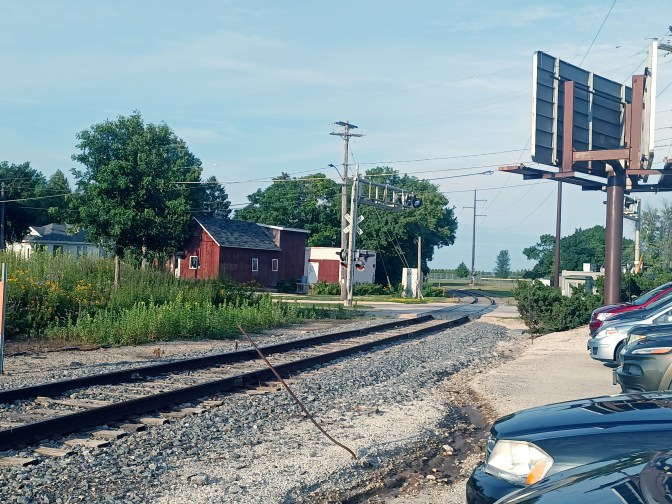
BIke to the Beat was amazing, even apart from a couple of wrinkles in the day, and I am grateful that there were no mechanical issues with the bikes, we had all the tools, I didn’t forget any pedals or anything, etc. More than that though, the kids enjoyed the hotel a lot and we took a little detour through Manitowoc on the way back, and it was really a good trip. I’m the type of person who is always trying to anticipate what might go wrong in order to avoid any pitfalls, and when things go off with no major issues, I am grateful.
I’m grateful, too, that after far too long, I got to video chat with a dear friend. I’m grateful, too that through everything, the friendship holds.
Wow, it’s been a full couple of weeks! Thank you all for your patience with me! I am certainly grateful for all of you!
If you enjoy my posts, please consider:
- Giving this post a “like”
- Sharing this post
- Subscribing to the blog
- Pledging monetary support
- Subscribing to my YouTube or Anchor.fm channels
- Patronizing the links that support this blog: Lilla Rose | Amazon
Thank you very much!
-
To Die for Harry Potter

As an Amazon Associate I earn from qualifying purchases through affiliate links to Amazon.com.
When speaking the truth is as terrible as uttering Voldemort’s name
The very first thing a reader learns about Harry Potter in the first book of the eponymous series (Harry Potter and the Sorcerer’s Stone in the US, Harry Potter and the Philosopher’s Stone almost everywhere else) is that he is “the boy who lived.” This, in itself, not so terribly interesting; in fact, the suburban life of his aunt and uncle’s family is downright mundane. It is as the story starts building its form that we learn that not only did Harry survive something awful, but that he lived only because of the sacrifice of someone else.
As Harry reunites with the “wizarding world” to which he was born, and of which he had no memory, he really must come to terms with being a celebrity precisely for being “the boy who lived.” In this fictional world, as a baby, not only had survived an attack from one of the most powerful wizards in history, but something had happened that made many wonder if that wizard had perished in the attempt.
As it turns out, that evil wizard, Voldemort, had not died. This becomes apparent in the course of the story, to different people at different points in time. The lines between the “white hats” and the “black hats” start to form, and Harry finds himself in the company and companionship of a good number of people who are willing to die for what is true and good and right as well as for Harry himself. Not only does he represent the embodiment of the movement against evil, but it is believed that it is only Harry who can deal the final blow to the evil wizard.
The character Harry, struggles with this mightily. He never asked for this, never wanted it, but this is where he feels he must stand. At the very least, he must do so to honor his mother, who died so that he might live. Nevertheless, as the series wends its way on, the number of deaths on the side of the “good guys” steadily rises. To some degree, Harry feels responsible for each one, but particularly so with those who died in the service of protecting him.
The thing is, in the Harry Potter books, all of these deaths are of fictional characters. None of the countless discussion boards (or fanfic sites) make them any less so. Each character was dreamed up and put to paper by the books’ author, J.K. Rowling.
Love her or hate her, J.K. Rowling wrote a series of books that are unmatched in sales and influence globally of perhaps any other book series. What makes it all the more improbable is that she did so in an age where people generally don’t read books as a hobby. We have so many other pastimes and distractions that reading books hardly crosses the minds of most people as a way to have fun. At the same time, she was able to build on this being the internet age by being accessible to readers through the internet through her website and social media. Gone the days of having to send a letter (or a dispatch via owl) and if one were lucky enough, one might end up with a digital “tweet” or some such. Because of this, she’s become a celebrity herself.
This wasn’t all advantageous for Ms. Rowling – over the years, she has expressed a number of opinions that ruffled feathers. Like her boy-wizard-hero, she’s shown backbone, and has generally stood up to the mob. I personally don’t agree with her on every single topic, but I have great respect for the writing she’s done, for her philanthropic efforts, and for being a woman of her own mind who actually seems to have thought about things and made her own opinions. In an age where we are plagued by the “mockingbird media” and statements are constantly focus-grouped and weighed to be “non-offensive”, this is a breath of fresh air.
A few days ago, the author Salman Rushdie was stabbed at an event in Chautauqua, New York . Rushdie is also one of the most famous authors alive, in some part due to his books, but more so over the firestorm which occurred in the wake of his book “The Satanic Verses” being published in 1988. In 1989, an Iranian fatwa against Rushdie was announced, and it seemed like Rushdie’s assassination over the book was almost inevitable. However, that was over 30 years ago, and since then Rushdie has lived a pretty quiet life.
That is, until on August 12, when at an event in Chautauqua, he was rushed at and stabbed, causing permanent injury and disfiguration, but luckily not ending his life. Understandably, J.K. Rowling, world-famous author herself, would feel shaken about such a thing. She tweeted her dismay, and received a death threat from the same type of character as the man who attacked Rushdie. Now, death threats on Twitter are nothing new, and who the supposed threat seems to be against seems to determine a lot about what Twitter will do to police this. However, although there has been some public support of Rushdie from well-known writers, it seems like most of it only goes so far as to wish him well, but does nothing to condemn the action. Rowling’s tweet merely calls the news “horrifying” , but apparently this was too far in some extremist’s eyes – someone like Rowling should know where to stay silent!
It remains to be seen whether anything will come of the threat against Rowling; it’s been a decade now since the last Harry Potter was published, so it is unlikely she’ll have anything like an Iranian fatwa against her due to the series. So many people are hesitant to lay judgement against or even name evil that is out there, a principle demonstrated almost comically in the Harry Potter books in how most of the wizards in Harry Potter’s world avoided uttering the name “Voldemort”. In this type of environment, exposing evil and speaking the truth becomes a most radical and dangerous act. My sincerest hope is that nothing comes of this to Ms. Rowling, that she doesn’t become a real-life casualty of defending the same type of things Harry stands for in her books. Have we really come to a point where she’s in danger of dying “for Harry”? Counting the deaths in a fiction series is one thing; counting them in real life quite another.
-
Wordle #421


Never played Wordle? Check out my Wordle strategy page!
Wordle explanations are posted a day late to ensure that no one accidentally sees the solution before playing.
Line 1: One of my typical start words. Only the “A”, but it’s in the correct place.
Line 2: Another base word, got the “H” in the right place now as well.
Line 3: I totally forgot about the “H” in the second place because I was having such a hard time thinking of what it could go with. Was there something that starts “AHA” or “WH” or “GH”… “RH”? When I saw I hadn’t played the “R”, somehow my brain said – “yes, play that!”
Line 4: So this gets weirder.. the “I” has to be in the last place because I don’t think there’s a word that exists that starts “IHA”. So now I’m just plugging letters in and guessing. “Ghazi”?
Line 5: Khadi? Oh, but it is a “KH”.
Line 6: “Khaki”! Victory! (And to think I even mentioned the rare “KH” in my guide that I wrote a couple days ago!)
Did you get this Wordle? Tell me about it in the comments!
Happy Gaming!
-
Wordle #420

Never played Wordle? Check out my Wordle strategy page!
Wordle explanations are posted a day late to ensure that no one accidentally sees the solution before playing.
Line 1: One of my typical start words. And… nothing
Line 2: Another base word, but only the “N” and not in the right place
Line 3: I don’t know why I picked a word with two “O”s, but I did, and the N is still not in the right place.
Line 4: After a little thought, I figured that there had to be a “U” and then the “U” and “N” would probably be together… but how to play a word with what seems to be one “U” when all these other letters aren’t used. I wasn’t even sure “punky” would be accepted; after all, I basically only know it in the context of the 1980s kids’ show Punky Brewster.
Line 5: So it’s got to be “junky”, right? Brilliant use of the “J”… What?!
Line 6: Seriously? Hunky? Are we all 14-year-old girls in 1988 or what?? At least the puzzle was solved.
Did you get this Wordle? Tell me about it in the comments!
Happy Gaming!
-
Wordle #419

Never played Wordle? Check out my Wordle strategy page!
Wordle explanations are posted a day late to ensure that no one accidentally sees the solution before playing.
Line 1: One of my typical start words. “B”, “E”, and “A” are all present, but in the wrong places.
Line 2: Let’s mix things up a bit. No progress except eliminating more spots.
Line 3: Same as last time. I accidentally played “B” in the first position again. It’s curious that the “E” isn’t in the 2nd, 3rd, or final positions, meaning that any word ending with “BE” is also eliminated.
Line 4: A lucky guess, in part, though it was the first thing that came to mind that had a “B” in the middle of the word.
Did you get this Wordle? Tell me about it in the comments!
Happy Gaming!
-
Musical Memory – Georgy Girl – The Seekers

As an Amazon Associate I earn from qualifying purchases through affiliate links to Amazon.com.
As a high school student, I almost never listened to current music on purpose. The end date for my musical tastes ended right around 1973, but I knew enough about the bands and the period that I could converse competently with adults more than twice my age about it.
The only Seekers’ song that was in regular rotation on the local “oldies” station, WJMK Chicago, was, of course, “Georgy Girl”. I always loved the song, from the upbeat whistling, to the encouragement given to a girl who seemed maybe as awkward as I was.
Later on, I would end up buying the entire Rhino 9-disc “British Invasion” collection (the first 4 came in a boxed, for the others, I had to keep checking at Best Buy over the course of many months to see if another disc was in stock) and finally heard songs like “I Know I’ll Never Find Another You” and learned a little bit more about the band – including that they are from Australia, not the UK!
Somewhere during that time, I also found the Seekers’ album “Georgy Girl” (LP, of course) at a yard sale for something like $1.50. The album really made me realize that the group was more of a folk group than most – not nearly as folkie as Peter, Paul, and Mary, but at the album level, there was a lot of overlap in songs. I had been a Peter, Paul, and Mary fan pretty much since I was born, and think that they have a lot of the best versions of a lot of folk songs. However, to hear Judith Durham sing alone made the Seekers’ versions worth it. I really consider her to be one of the best female singers out there.
And so, this music memory is to mention the death of Judith Durham, who passed away this week at the age of 79. I consider all the public weeping and wailing over celebrities and musicians pretty weird, but there is a certain sadness that comes about when someone so very talented is no longer with us.
Back to Georgy Girl, though. As I was learning to play recorder, there were two “hard” songs that I worked on a lot to be able to play. One was “Jig” from The Little Mermaid, but first, there was Georgy Girl. I remember sitting in my grandmother’s farmhouse, using the music from Great Songs of the Sixties as a guide when I couldn’t quite figure things out by ear. I think it was the first song I ever played that heavily used the second octave, and I learned how to play it – and developed muscle memory – with a couple of the notes fingered incorrectly (or shall I say, “alternatively”). It was a song that I played many, many times down the halls of my high school. It was a song that was instantly recognizable, cheerful, and powerful enough with the high notes so as to allow the recorder not to get instantly drowned out by the noise of hundreds of high school kids milling about. More than that, it’s a song that Judith Durham sang so perfectly it almost immediately became a classic.

As always, I am thankful for the music!
-
Wordle #418

Never played Wordle? Check out my Wordle strategy page!
Wordle explanations are posted a day late to ensure that no one accidentally sees the solution before playing.
Line 1: One of my typical start words. “E” and “A” are both present, but in the wrong place.
Line 2: I guess that the “ea” might just need to be shifted over one position. I try this and I am correct. No luck on the other letters, though.
Line 3: No progress here except for eliminating more letters. There are a lot of “ea” words, and I wonder if I’m going to get this one.
Line 4: I am shocked that this was correct, though it was the only thing I could think of using “gl” that wasn’t “gleam”.
Did you get this Wordle? Tell me about it in the comments!
Happy Gaming!
-
Wordle #417

Wordle explanations are posted a day late to ensure that no one accidentally sees the solution before playing.
Line 1: One of my typical start words. Nothing.
Line 2: “Fling” is one of my base words – Wow!
Line 3: Let’s go for “cling” – Hooray!
Did you get this Wordle? Tell me about it in the comments!
Happy Gaming!
-
Video post – Choose a Bible!

This video was inspired by a conversation with a friend a couple of weeks ago. Often, I see people ask the question online “Which is the best Bible translation to read?” Other times, I’ve heard people have the attitude that the Bible is impossible to know because every translation is different, and even if one can read the original languages, so many of the cultural references are lost.
-
Wordle #416

Wordle explanations are posted a day late to ensure that no one accidentally sees the solution before playing.
Line 1: One of my typical start words. “A” and “T” are in the word, but in the wrong places. Not much to go on.
Line 2: “A” and “T” are now in the right places, but none of the other letters are correct. There are really a ton of words that this could be.
Line 3: No progress here except for eliminating more letters. Very frustrating.
Line 4: And again. I’m clueless and worried that I’m not going to get this one. I consider playing a word that would simply use up more of the unused letters, rather than keep playing the “A” and “T”.
Line 5: I decided against just playing words for letters & go with “patty” because at this point, I can’t think of much more that it could be. Luckily, it’s the word! Phew!
Did you get this Wordle? Tell me about it in the comments!
Happy Gaming!
-
Reading Laura as an Adult

As an Amazon Associate I earn from qualifying purchases through affiliate links to Amazon.com.
Little House on the Prairie was a television phenomenon that was ongoing at the time I was born. Of course, it *could* be complete coincidence, but during my first year in college, there were three Lauras on my floor alone. This isn’t to say that the book series wasn’t already well-known – pretty much from the time that they were published, the “Little House” books were incredibly popular. However, the television series probably did the most to enshrine Laura Ingalls Wilder’s stories from mere books to legend.
As a kid, I read a number of the “Little House” books. If I remember correctly, I read Little House in the Big Woods, Little House on the Prairie, Little Town on the Prairie, and (though technically not part of the series), West from Home. I liked them well enough, though I also remember starting By the Shores of Silver Lake and These Happy Golden Years because I never really “got into” them. Laura has a very matter-of-fact way of recounting the stories of her life, and as a kid, it hardly seemed strange that her family would be travelling around the US, settling here and there. As young as the narrator is at the beginning of the series, not only is there no self-pity, there’s almost the attitude, even in the earliest stories, that of course life was difficult, but that it was a given that family pulled together to get through it all.
Everyday life in Laura’s time
As a homeschooling mom, I wanted my kids to have some familiarity with the Little House books as a matter of course, to understand a little bit about living in (American) history, and to get a glimpse of life as it was not all that long ago. Especially now with the advent of the internet (and gaming systems), I think it’s especially hard for kids to even imagine what life was like without these or have any perspective of when or how these changes happened. (Once, when the power went out due to a storm a few years ago, one of my children – then around 8 – asked me if the lack of electricity reminded me of growing up in the 1980s!)
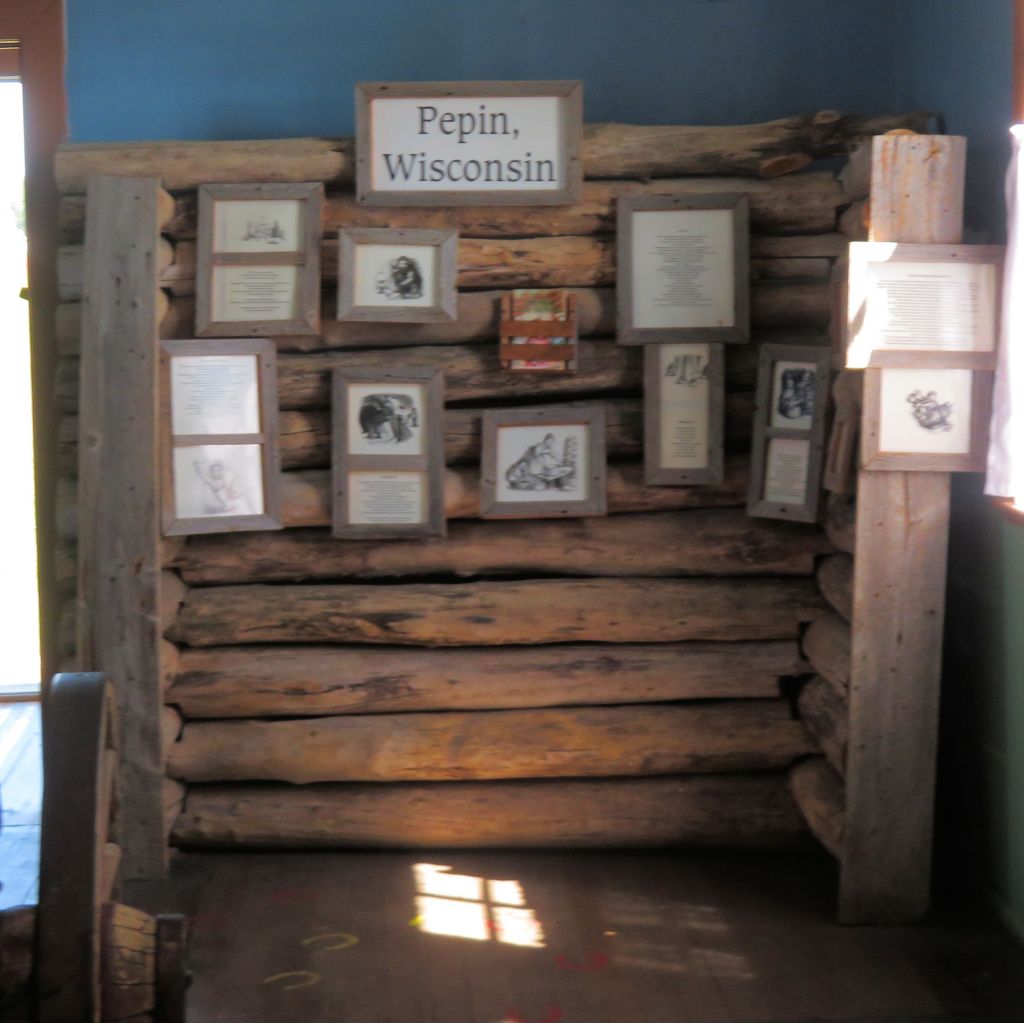
Laura Ingalls was born in 1867, near Pepin, Wisconsin, in a pre-industrial age. By the time she died in 1957, at age 90, industrialization had radically changed the way most people in the United States lived. Even in the 1930s, when the books began to be published, many of the things and processes that she describes had long since disappeared. For example, her family travelled thousands of miles in a covered wagon, but the advent of the railroads made the covered wagon obsolete. Even in my lifetime, my dad usually referred to the refrigerator as the “icebox”, but the Ingalls didn’t even have that; food was smoked and canned or otherwise preserved in season to allow the family to eat year-round, but already in the 1920s, electric refrigerators were common in US households. Wilder herself acknowledged the huge change in the way of life at the beginning of the series, mentioning how a lot of what she was writing about was how “grandma did things”.
As an adult, with a perspective of decades now, it’s insane to imagine that much change in such a short amount of time. Yes, I still remember a time before the internet was a thing, when people called each other on phones without caller-ID that were plugged into the phone jacks in the wall, when using checks (especially in small towns) was at least as common as credit cards, etc. However, as I read somewhere awhile back – if someone from 1950 visited a home in 2020, things would look a lot different, but even so, a large percentage of them would look familiar. If someone from 1880 visited a home in 1950, imagine the shock at the difference, say, at how a kitchen was set up. Or think of it this way – in 1880, the Amish may have seemed a little “old fashioned”, but in 2020 they seem like they belong to a different time completely!
The amount of the frontier the Ingalls saw and experienced
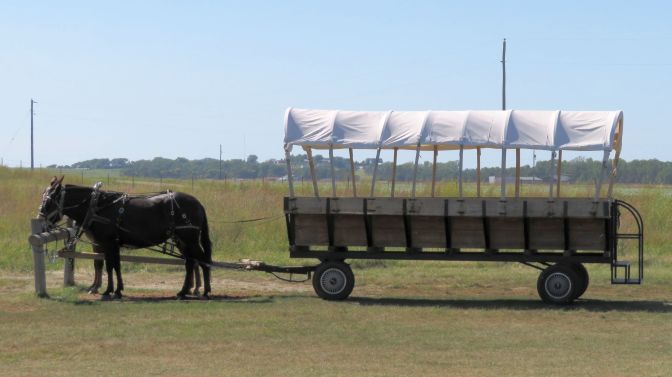
Also, as an adult, it seems almost crazy in the amount of moving the Ingalls did, considering how difficult moving was. Both of Laura’s parents came from families (the Ingalls and the Quiners) that seemed determined to keep moving with the edge of civilization. In Wisconsin, there was family nearby, but then Laura’s family moved to Kansas, back to Wisconsin, Minnesota, Iowa, back to Minnesota, and then to South Dakota. With the exception of the move to South Dakota, these moves were made in a covered wagon at a rate of 20-30 miles a day, with all one’s possessions in a wagon. The animals pulling the wagon needed to be fed and tended to, and there was constant risk of wild animals and bandits. Interestingly, Laura spends a lot of time and goes into great detail talking about her father’s gun and the care he took to keep it in good condition. The longest discussion of this happens in Little House in the Big Woods, which, in the book account, begins when Laura is four, because even then she understood how the gun was so incredibly important not just for hunting, but for protection from a number of possible scenarios.
The Ingalls family – minimalism and “tiny house” pioneers
It’s also startling to understand how few possessions the Ingalls owned. When Laura talks about packing up the house in a morning to move at the beginning of Little House on the Prairie, it seems almost an impossible feat. However, after visiting one of Laura’s homes in South Dakota, then it made a lot more sense. When she talks about a “little house”, she’s not kidding. In the book “By the Shores of Silver Lake“, Laura talks about being able to move into the Surveyors’ House, and from the way she describes it, it sounds like a mansion. When visiting De Smet, South Dakota, I was absolutely shocked to see the Surveyors’ House. It has been moved from its original location, but it still stands in De Smet. It is tiny. It’s smaller than most of the small houses in town. My grandmother lived in a house in the country whose original section was built by her grandparents in the 1890s. It certainly wasn’t big (which led to it being expanded by quite a bit later) but it was probably at least twice as big as the Surveyors’ House.

Ever wonder how Pa could build a house by himself in a matter of days? With a house this small, it’s actually possible! 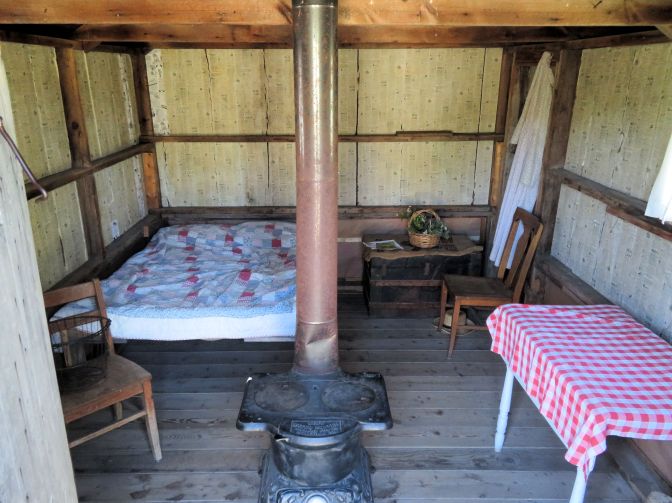
The interior of one of the South Dakota “Little Houses”. There is a loft not pictured here, which looks a lot like a sleeping loft in a modern tiny house, but the loft gives it a lot more space than their sod house, for example. 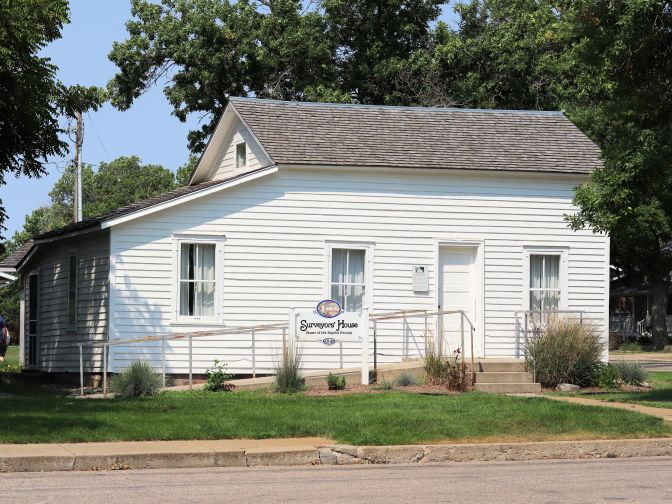
The Surveyors’ House A hard life
It seems that one of the things that really sticks out to people reading the Little House books as adults today is the amount that the Ingalls had very few comforts – life was hard and it was a lot of work. There was no delusion that if one worked hard one would become rich or famous. Part of the fabric of life was that there was work to be done, and it was each person’s responsibility to do what they had to do. If one was able to make it a little out of poverty, that was admirable, but it wasn’t guaranteed. The criticism comes especially to Laura’s father, whose wanderlust, in their eyes, seemed to contribute to their poverty. It is a stark contrast to today, where even a lot of poor people in the United States live relatively comfortable lives. Many seem to think that this way of life – “deprivation” in their eyes – is tantamount to child abuse.

A corncob doll, made much in the way that Laura’s doll Susan was made. Through it all, there is a strong sense that character and honor are more important than whether one is rich or poor.
Understanding one’s parents
Related to this, Laura always writes positively about her parents, even when the situations were extraordinarily difficult. Part of this, I believe, comes from the way she was raised; she had the understanding of the duties and responsibilities her parents had. I have no doubt that her parents were amazing people, but I also wonder that since she was writing this at a point where her own independent & headstrong daughter was grown up that she may have been more gentle towards them in the retelling. I’m sure it does help that Laura seems to have had a good bit of wanderlust herself, and ended up moving again a number of times as an adult. Furthermore, even as a young bride, she and her husband experienced a lot of hardship and tragedy, including the death of a baby , illness, and a house burning to the ground.
Learning to be eyes for the blind (including the reader)
Another thing that strikes me in the writing of these books is how descriptive she is of the scenes. On one hand, people back then were much more cognizant of the signs of nature, and generally could name a lot more of the plants and animals around, but when her sister Mary lost her sight, Laura’s father told her that she needed to be Mary’s eyes. I have to think that the practice of describing things in fine detail to her sister helped her not only notice more around her, but also put those descriptions into cognizant thoughts and words, which would later assist her when writing the Little House books.

One of Mary Ingalls’ books in Braille In the 1940s, Garth Williams was tasked with illustrating the entire Little House series. He did an incredible amount of research, meeting and speaking with Laura, using the books as source material for his illustrations, and travelling to many of the locales mentioned in the books. In 1953, he had this to say about finding the location of Laura’s family’s house along Plum Creek:
I did not expect to find the house, but I felt certain that it would have left an indentation in the bank. A light rain did not help my search, and I was about to give up when ahead of me I saw exactly what I was looking for, a hollow in the east bank of Plum Creek. I felt very well rewarded, for the scene fitted Mrs Wilder’s description perfectly. I took my pictures, and returned to Walnut Grove..”
(via werewolf.co.nz)The combination of her descriptions and his illustrations make the stories come to life for young and old alike. I’m not usually one who pays much attention to illustrations, but the Williams’ illustrations help make clear things that Laura spends time describing, such as the smoker that was built in “Little House in the Big Woods”. Having no experience myself with building such a contraption, although her description is correct, it’s with the illustration that it really makes sense. Without her description, though, the illustration probably would not have had nearly the amount of authenticity.
These Happy Golden Years/The First Four Years
One of the reasons I didn’t read These Happy Golden Years as a kid was because of the cover of the book, where Laura is standing with Almanzo, in a pose that is obviously of the two of them courting. As a kid, reading about the “grown up” Laura wasn’t necessarily interesting. As an adult, I picked up the book and was shocked that when she talked about “these happy golden years” she was talking about being between 16 and 18 years old! I was not mistaken that the book talks about her courtship with Almanzo, but this happened much earlier than I ever really considered. The “Golden Years” refer to a period of time in her life when her family was settled in one place, she had a good deal of independence, she had her own social circle, and she was not yet burdened by the crushing responsibility of being in charge of a homestead and a family.
The First Four Years is a little different, as it wasn’t a finished manuscript when it was found after Laura’s death. It’s a basic account of the first four years of her marriage, and probably the start to a more fleshed-out book. In any case, whereas the rest of the series is pretty upbeat – even with The Long Winter, which really flirts with the ideas of depression, resignation, and even giving up – in general, they still have a streak of determination and hope that runs through. Had this book been finished, it very well could have been framed in the same manner, but as it stands, it begins with Laura and Almanzo’s wedding, and recounts the hardship, disaster, and catastrophe that followed them those first four years. It does serve as a kind of bookend to the beginning of the series; as a kid, Laura sees a lot of their life as an adventure, as an adult, here’s the realization that keeping going is a lot harder than it looks.

The nine books of the Little House “canon”. These are full-color special editions, which I feel are well worth the price. The links to the individual books of this edition are linked throughout the post. I still believe that these books are fun and worthwhile for kids. The life of Laura Ingalls Wilder was unique in many ways, but the fact that she’s able to create familiarity with wide swaths of people in the way she writes is an amazing feat. Her writing also captures a very short, but very influential, period in American history. For those who haven’t read them, I would recommend picking them up, because they really aren’t just for kids. For those who have read them as children, there’s really a lot more to pick up on as an adult, whether you read them on your own or along with kids.
Note on the pictures: Nearly all the pictures in this post were taken at the Ingalls Homestead outside of De Smet, South Dakota in 2020 and 2021. Whether one is a Laura Ingalls Wilder fanatic or just interested in this period of American history, it is well worth visiting.
Amazon links to the books in the series (full color editions, unless otherwise noted):
- On the Way Home
- West from Home (regular paperback)
-
Subscribe
Subscribed
Already have a WordPress.com account? Log in now.
 Breath of Hallelujah